
When I had just created (The Mother) Gunzi, it already had exactly the same rules, but the board was much larger (67 spaces) and many more pieces were used (2 × 17). In this form, Gunzi proved to be very difficult to fully grasp. Moreover, it was impossible to write a working computer program for it, since the server would immediately crash as soon as it tried to calculate even two moves ahead. At that time, however, I had already made a small promotional video using the large board.
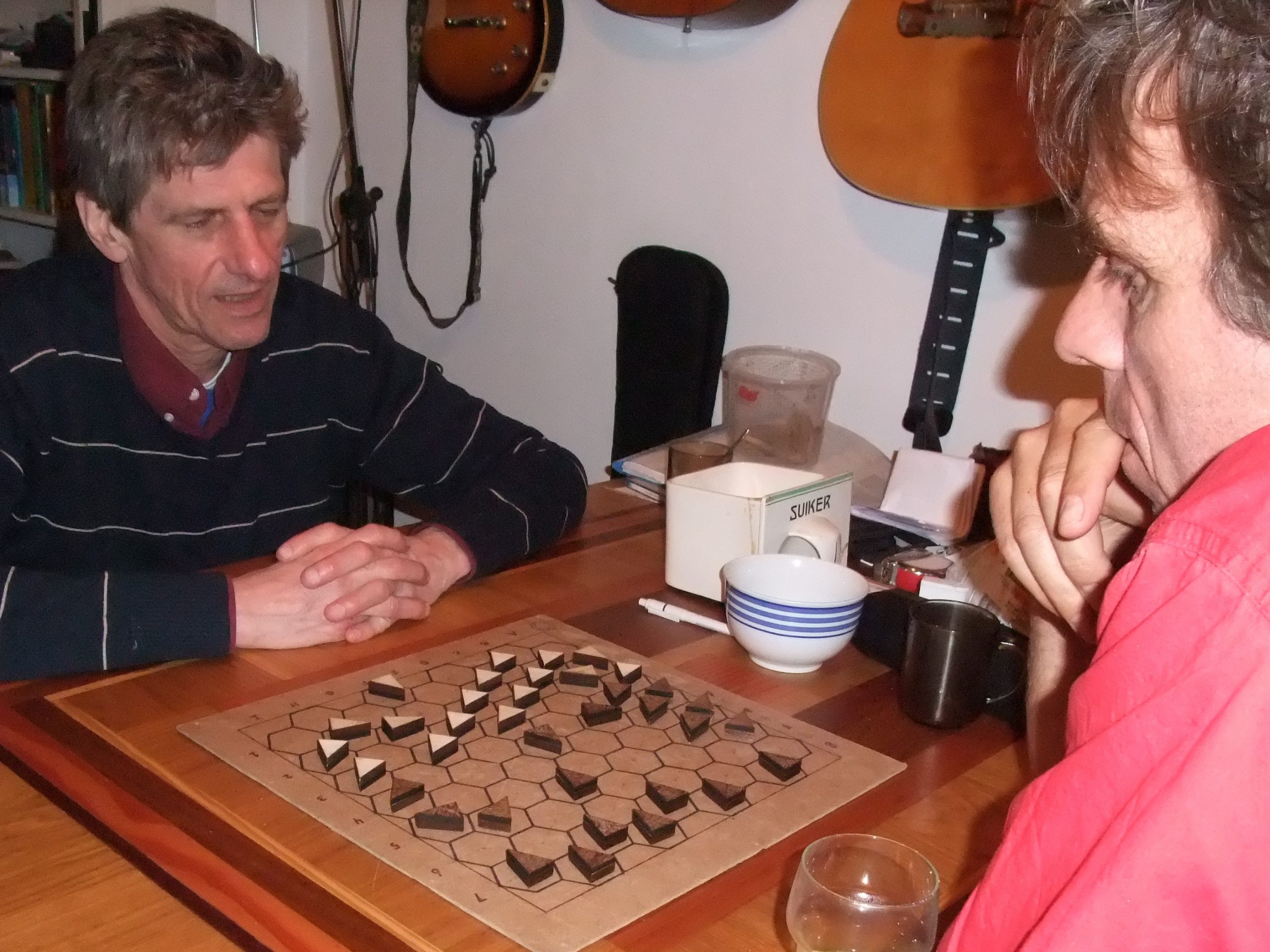
The future programmer Ed and I are playing one of the first games of Gunzi on the large board.
Soon the idea arose to make it more manageable. So we decided to reduce its size.
There turned out to be many possible shapes. As long as the board remained symmetrical, the game could be played on all of those shapes. The ideal ratio between the number of pieces and the number of spaces turned out to be approximately 1 to 1.9.

The smallest possible shape on which the game could still be played properly became our starting point.
Because it is important to be able to reproduce a game, I devised the following notation system.
The nice thing is that if many true grandmasters ever emerge and the game becomes too simple for them, the board can easily be expanded. This can be done either by adding two vertical lanes next to each other (+7 spaces) or by adding one horizontal lane both at the bottom and at the top (+10 spaces).
In this way, two new games are created, each requiring very different playing techniques and both, in any case, considerably more difficult.